Heying & Giesing
Ancestral Home in Bocholt, Germany
St. Georg's Catholic Church Homepage
St. Georg's Catholic Church photos

Great Grandpa Adolph Heying's Family in RHINELAND, MO
Great Grandma Caroline Giesing Heying's Family in CHAMOIS, MO
Giesings in BOONVILLE, MO

View Marraige and Death CERTIFICATES of Ancestors
Back to Mike Montgomery's Ancestors

BOCHOLT, GERMANY

On both sides of his family my grandfather Hubert F. Heying represents the fourth generation to have lived in Missouri. The parents and grandparents of both Adolph and Caroline immigrated to Missouri in the mid-1800s from Bocholt, a village of 4,000. At that time part of Prussia, Bocholt is today a city of 75,000 inhabitants located in the northwestern part of modern day Germany. It is located in the north-west part of the largest state in Germany, North Rhine-Westphalia, forty-three miles north of Düsseldorf, and two and one-half miles south of the Netherlands. Though the city is twelve miles north-northeast of the Rhine River, it does have its own River- the Aa (from the old Dutch, meaning "water") which does flow through town. The name Bocholt comes from Buchenholz, or "beech wood," which grows in this area.

Bocholt's proximity to water moderates its climate. The average temperature of Bocholt in January is 36 °F and in July 65 °F. Its average annual precipitation is about 30 inches. The mean temperature in Missouri is somewhat similar- in January it is 30 °F and in July 76 °F- although, because the state is inland, extremes of temperature are much greater than those experienced in Bocholt. Annual precipitation is 40 inches for Missouri- again, not a great contrast. Many German immigrants who had been farmers in Germany claimed that the hills of the Missouri River valley area reminded them of the Rhine River area of Germany. Perhaps the similarities between the two places gave them the confidence to feel they could successfully farm in Missouri, which would explain why so many decided to make the move.

GIESINGS IN BOCHOLT

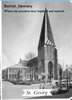
One of the many historic buildings in the city of Bocholt is the Gothic Catholic Church St. Georg's (http://www.st-georg-bocholt.de), built between 1415 and 1486 (though as church was built on the site as early as 800 as a mission to the Saxons). It is the church where my Heying and Giesing ancestors for many generations were christened, married, and were buried before the migration of those family members who left Germany in the mid 1800s. I am aware of family members in Carolin Giesing's line going back four generations- Derck Schulten, Joannes te Hutte gnt Kleine Gries, Bernard Johannes Wesselius Kleine Gries, and Maria Frederica Klein Gries or Kleinegries- as well as two generations in Adolph Heying's line- Bernardo Heying and Joannes Wilhelm Heying. All lived in Bocholt.

Coming from Caroline Giesing's side of my family eight generations before me, Derck Schulten was born about 1660 and died before 1749 in Bocholt. On April 23, 1712, he married Gerarda te Hutte, the daughter of Johan ter Hutte and Willemken Tervoort, at St. Georg's. She was christened on May 1, 1677 at St. Georg's and died sometime after 1750 in Bocholt. She was also known as Gertjen ter Hutte and Gertrudij, her baptism sponsors were Arndt Griesz and Elsken Logelandt.

Also on the Giesing side of my family, seven generations before me, Joannes te Hutte gnt Kleine Gries was born to Derck and Gerarda in 1715 in Bocholt. He was christened on December 26, 1715 in St. Georg's and died on July 31, 1794 in Bocholt. He was a "Boerlandarbeider", and his sponsors at baptism were Johan te Hütte and Johanna te Grunde. On September 5, 1754, Joannes te Hutte gnt Kleine Gries married his second wife at St. Georg's Church. She was Joanna Christina Betting, the daughter of Bernt Eppinck gnt Betting and Gerarda Legeland, and had been christened on January, 22 1728, at St. Georg's. Her baptism sponsors were Bernt Betting and Elisabeth ter Hütte. Marriage witnesses were Herman Kleinegries and Hermann Buszkamp. Joannes and Johan are the parents of Bernard Johannes Wesselius Kleine Gries.

Six generations before me on Caroline Giesing's side of my family, Bernard Johannes Wesselius Kleine Gries was born to Joannes and Joanna in 1755 in Bocholt. He was christened September 23, 1755 at St. Georg's and his baptism sponsors were Johannes Hermanus Lamers and Elisabeth Betting. Bernard married Adelidis Smeing, the daughter of Hermanus Smeing and Anna Catharina Hegering, on May 1, 1782 in St. Georg's. She was christened on December 9, 1754 in Bocholt and died on 12 January 12, 1817. She was also known as Aldegondis and Schmeinck. Marriage witnesses were Joan Wilhelm Smeing and Wessel Klein Gries. Bernard and Adelidis are the parents of Maria Frederica Klein Gries.

Five generations before me on the Giesing side of my family, Maria Frederica Klein Gries (Kleinegries) was born to Bernard and Adelidis in 1790 in Bocholt, where she was christened on December 29, 1790 in St. Georg's Church. Also known as Marie, she was living in Löwick near Bocholt at the time of her marriage to Sebastain Weneslaus Giesing on January 6, 1824 in Werth, Isselburg, Germany. Sebastain Weneslaus Giesing, also known as Wessel, was born in 1784 in Germany and died after 1870 in Chamois, Missouri. Per 1870 Census, he was living in Osage County, Missouri. Sebastain Wenenslaus and Maria Frederica most likely came to America with my great great grandfather Wilhelm Giesing, Caroline Giesing's father. He was born on November 25, 1824 in Wesel, Germany, just south of Bocholt on the Rhine River. Wilhelm (William) married Theodora Schepers on July 11, 1853, in the New World, at St. Joseph Catholic Church, in Rhineland, Montgomery County, Missouri, where they both must have lived at the time. Then sometime between 1860 and 1862 the family moved to the village of Chamois in Osage County, Missouri.


HEYINGS IN BOCHOLT

The two Heyings I am aware of in Bocholt are Adolph's grandfather and great grandfather. His great grandfather Bernardo Heying was born in 1758 and died on November 21, 1794, in Bocholt. Bernardo's wife Maria Elizabeth Mumbeck was born March 9, 1762, and died April 28, 1795, also in Bocholt.

And finally, Adolph's grandfather Joannes Wilhelm Heying, born October 27, 1790, in Bocholt, married Aleida Epping, born 1796. They also emigrated from Bocholt to the New World and settled in the Rhineland-Starkenburg-Americus area of Missouri in 1848 with their seven children, one of whom was my great-great grandfather Frantz.


LEAVING BOCHOLT

Though life was already hard, several things occurred around the Bocholt area in the early 1800s which helped to make life there even more uncomfortable. Most Westfalian families supported themselves by farming, but farms were small and land was hard to come by, so farming families had to supplement their income by spinning and weaving in the home. Unfortunately, with the onset of the industrial revolution, the cottage handloom industry began to succumb to competition from machines. Around the same time cotton was starting to replace linen, and by 1846 linen sales were at an all time low. On top of this grain harvests were poor 1846-47, and, as in Ireland, the potato crop was failing. In 1848 a revolution attempt had failed in Germany, and many who had supported the failed uprising fled the country. Such was the environment my family and thousands of others left in 1848.

A popular route for German emigrants at this time was a weeks long boat trip from Bremen to New Orleans, followed by a steamboat ride up the Mississippi River to St. Louis. The final destination for many Westfalians was the Missouri River valley. More often than not, emigrants would follow the route of family or neighbors who had left home before them. After their journey they would find their acquaintances and build a home near them, once again becoming neighbors in their new settlement in Missouri, in a process known as "Chain Migration." German immigrants tended to stay in the same area, often for several generations, once they had settled and established a homestead. Since this was a typical pattern of migration, it was no mere coincidence that the parents of Hubert F. Heying met and married, and that both could claim similar backgrounds with families in Bocholt.